
Chatham NJ Light Switch Replacement
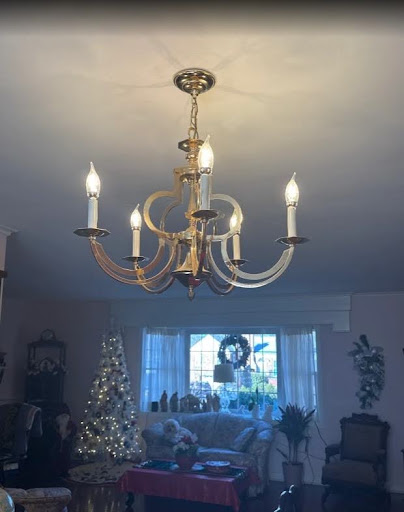
Restoring Reliable Operation to a Dining Room Chandelier
Diagnosing the Real Cause of a Dining Room Lighting Problem
When a chandelier suddenly stops working or begins experiencing intermittent power issues, it can be tempting to assume that the fixture itself has failed. In many cases, however, the problem may originate somewhere else in the electrical circuit.
That was the situation for a homeowner in Chatham, New Jersey, who contacted First Class Electric after experiencing a power issue with a dining room chandelier. The homeowner wanted the problem diagnosed and repaired so the fixture could once again operate reliably.
Eduardo responded to the service call and carefully inspected the electrical system serving the chandelier. Rather than immediately replacing the fixture or recommending unnecessary electrical work, he traced the problem to its actual source: a failing dimmer switch.
The defective dimmer was removed and replaced with a new single-pole switch at the existing location. Once the repair was completed and tested, the dining room chandelier was operating normally again.
The homeowner was extremely pleased with Eduardo's professionalism and workmanship, leaving this five-star review:
"Eduardo Monroy electric very nice and professional for this work. I am recommending very much. Glad to find this company. Eduardo very best!!! Thank you."
This project is a good example of why proper electrical troubleshooting matters. Identifying the actual source of a problem can often eliminate unnecessary repairs while restoring the electrical system quickly and efficiently.
The Homeowner's Lighting Problem
The homeowner's dining room chandelier had developed a power problem.
Because chandeliers can contain multiple bulbs, decorative wiring, and complicated fixture components, it would have been easy to assume that the fixture itself was responsible.
However, electrical lighting problems can originate at several different points, including:
- Light switches
- Dimmer switches
- Electrical connections
- Wiring
- Circuit breakers
- Fixture components
- Loose or damaged connections
Determining which component is actually causing the problem is an important part of professional electrical troubleshooting.
Instead of replacing parts unnecessarily, Eduardo began by evaluating the chandelier's electrical supply and control.
Diagnosing the Failing Dimmer Switch
During his inspection, Eduardo determined that the chandelier itself was not the primary problem.
The issue was traced to the existing dimmer switch controlling the dining room light.
Dimmer switches contain electronic components that regulate the amount of electrical power delivered to compatible lighting. Like any electrical device, they can eventually wear out or fail.
A failing dimmer can produce symptoms such as:
- Lights that don't turn on.
- Intermittent operation.
- Flickering.
- Inconsistent power.
- Lights that turn off unexpectedly.
- Difficulty controlling the fixture.
In this case, the dimmer switch had reached the point where replacement was the appropriate solution.
Expert Tip
When a light fixture suddenly stops working, don't automatically assume the fixture needs to be replaced. The problem may be located at the switch, wiring, breaker, or another point in the circuit. Professional troubleshooting can identify the actual cause before unnecessary parts are purchased.
Replacing the Defective Dimmer
Once Eduardo identified the failing dimmer as the source of the problem, he explained the recommended repair to the homeowner.
The solution was straightforward: remove the defective dimmer and install a new single-pole switch at the existing location.
The project involved:
- Removing the failing dimmer switch.
- Inspecting the existing electrical connections.
- Installing the new single-pole switch.
- Securing the wiring connections.
- Installing the switch properly in the electrical box.
- Testing the chandelier.
- Confirming reliable operation.
Because the existing electrical location and wiring could be used, there was no need for extensive rewiring or unnecessary modifications.
This kept the project focused on the actual problem.
Why Replacing Only the Failed Component Matters
One of the most important aspects of this repair was identifying what didn't need to be replaced.
The chandelier itself was not the problem.
The home's existing wiring did not require extensive modification.
The electrical box did not need to be relocated.
The homeowner simply needed a reliable replacement for the failed dimmer.
This is an important principle of professional electrical service: repair the problem rather than unnecessarily expanding the project.
A thorough diagnosis allows homeowners to make informed decisions and can save both time and money.
Single-Pole Switch vs. Dimmer Switch
The original control was a dimmer switch, while the replacement was a standard single-pole switch.
A single-pole switch is one of the most common types of residential light switches. It allows a light fixture to be turned on or off from one location.
A dimmer, by comparison, provides adjustable lighting levels.
There are situations where a homeowner may prefer a standard switch because of:
- Simplicity.
- Reliability.
- Ease of operation.
- Compatibility.
- Lower maintenance requirements.
The appropriate switch depends on the fixture, wiring configuration, homeowner's preferences, and compatibility requirements.
In this case, the new single-pole switch provided the reliable operation the homeowner needed.
Testing the Dining Room Chandelier
Replacing the switch was only part of the job.
After completing the installation, Eduardo tested the chandelier to verify that the electrical circuit was functioning correctly.
Testing helps confirm:
- The switch operates properly.
- Power is reaching the fixture.
- The chandelier turns on and off reliably.
- Electrical connections are secure.
- The original problem has been resolved.
A repair should never be considered complete simply because a new component has been installed. The system should be tested to make sure the original symptom has actually been corrected.
Why Professional Light Switch Replacement Matters
A light switch may look like a simple electrical component, but it is part of a larger electrical circuit.
Professional switch replacement involves:
- Identifying the correct circuit.
- Safely disconnecting power.
- Inspecting existing wiring.
- Verifying switch compatibility.
- Making secure electrical connections.
- Properly mounting the new switch.
- Testing the completed circuit.
Improper Replacement | Professional Replacement by FCE |
Switch replaced without diagnosis | Problem identified before repair |
Fixture may be replaced unnecessarily | Existing chandelier preserved |
Wiring may not be inspected | Existing connections evaluated |
Compatibility may be overlooked | Appropriate switch installed |
Limited testing | Complete operational verification |
The goal isn't simply to install a new switch. It's to restore the electrical system safely and reliably.
Common Signs a Light Switch May Need Replacement
Homeowners should pay attention to changes in how their switches and lights operate.
Potential warning signs include:
Flickering Lights
If a fixture flickers when the switch is operated, the switch or another component may require inspection.
Intermittent Operation
A light that works sometimes but not others can indicate a failing switch or electrical connection.
Unusual Heat
A switch that becomes unusually warm should be evaluated by an electrician.
Buzzing or Crackling
Unusual sounds from a switch can indicate an electrical problem.
Loose Switch
A switch that moves excessively inside the wall box may require attention.
Complete Loss of Power
If a fixture suddenly stops working, the switch is one of several components that should be evaluated.
Not every lighting problem requires switch replacement, which is why proper diagnosis is important.
Homeowner Tips for Maintaining Residential Lighting
A few simple practices can help homeowners identify electrical problems early.
Don't Ignore Unusual Symptoms
Flickering, buzzing, heat, or intermittent operation shouldn't be dismissed.
Avoid Repeatedly Resetting Breakers
If a breaker repeatedly trips, the underlying problem should be investigated.
Use Compatible Lighting Controls
Dimmer switches must be compatible with the bulbs and fixtures they control.
Have Older Electrical Systems Inspected
Professional inspections can identify aging components before they fail.
Address Small Problems Early
Replacing a failing switch is generally much simpler than dealing with a larger electrical failure later.
Frequently Asked Questions
How do I know if my light switch is failing?
Intermittent operation, flickering, unusual heat, buzzing, crackling, or difficulty turning a light on and off can indicate a switch problem.
Can a chandelier stop working because of a bad switch?
Yes. The switch controlling the chandelier can fail even when the fixture itself is functioning properly.
Can a dimmer switch be replaced with a regular switch?
In many installations, yes, provided the wiring configuration and fixture are appropriate for the replacement switch.
Should I replace a chandelier if it stops working?
Not necessarily. An electrician should first determine whether the problem is with the fixture, switch, wiring, breaker, or another component.
How long does light switch replacement take?
A straightforward switch replacement can often be completed quickly once the source of the problem has been identified.
A Simple Repair That Restored an Important Part of the Home
For this Chatham homeowner, a dining room chandelier that wasn't operating properly initially appeared to be a potentially complicated electrical problem.
Eduardo's careful troubleshooting revealed something much simpler.
The chandelier itself did not need to be replaced. The home's existing wiring did not require extensive modification. Instead, the problem was traced to a failing dimmer switch.
By removing the defective dimmer and installing a new single-pole switch at the existing location, Eduardo restored dependable operation to the dining room lighting quickly and efficiently.
The homeowner's five-star review reflects the experience we strive to provide on every service call: professional workmanship, accurate diagnosis, straightforward solutions, and respectful customer service.
Whether we're completing a Chatham NJ Light Switch Replacement, troubleshooting a chandelier, installing new lighting fixtures, replacing dimmer switches, upgrading electrical panels, or handling larger residential electrical projects, First Class Electric focuses on solving the actual problem—not selling unnecessary work.
Our commitment to quality workmanship and customer satisfaction is backed by our Lifetime Workmanship Warranty, giving homeowners throughout Chatham and Central New Jersey added confidence in every electrical repair and improvement.